Israelis vote for parties. Whoever can hold 61 of the 120 seats together governs.
You have probably been shown Israeli politics as one man. Coverage abroad reduces the country to Benjamin Netanyahu, and the rest of the parliament disappears: the parties that make and break his governments, the generals who run against him, and the Arab parties that sit in the Knesset and, after the vote of 27 October 2026, may decide who governs.
The final count had no bloc at 61. Netanyahu's bloc stood at 53, the bloc behind former military chief Gadi Eisenkot at 48, and the two Arab lists at 19. What happens next is set by law, step by step, and every step is below.
The clock, from the count to a government
Israel is never without a government. The outgoing one stays in office as a caretaker, with full authority over security, until a new one is sworn in. The steps run on a fixed clock set by Basic Law: The Government.
- ConsultThe president meets every party leader and gives the mandate to the member of Knesset judged most able to form a coalition. That is usually the leader of the largest party, but not always: what counts is who the other parties recommend.
- 28 + 14 daysThe first candidate negotiates a coalition, with one possible 14-day extension.
- 28 daysIf that fails, the president has three days to pick a second candidate, who gets 28 days and no extension.
- 21 daysIf that fails too, any candidate backed by a petition of 61 members gets the mandate, with 14 days to finish.
- 90 daysIf nobody succeeds, the Knesset dissolves and a new election follows about 90 days later. Israel ran five elections between 2019 and 2022 this way.
A government needs a majority of the members present, not 61 votes. It takes office when more members vote for it than against it. A party that abstains, or stays out of the room, can let a government in without joining it. That is the lever the smaller parties hold.
Losing a majority does not end a government. Three things do. A constructive no-confidence vote, which since 2014 needs 61 votes for a named replacement government in the same vote, a bar the Israel Democracy Institute calls among the most rigid in the world. A budget that fails to pass by the end of March, which dissolves the Knesset automatically. Or the Knesset voting to dissolve itself, as the 2021 coalition did in 2022 and the outgoing Knesset did, 62 to 0, on 17 July 2026.
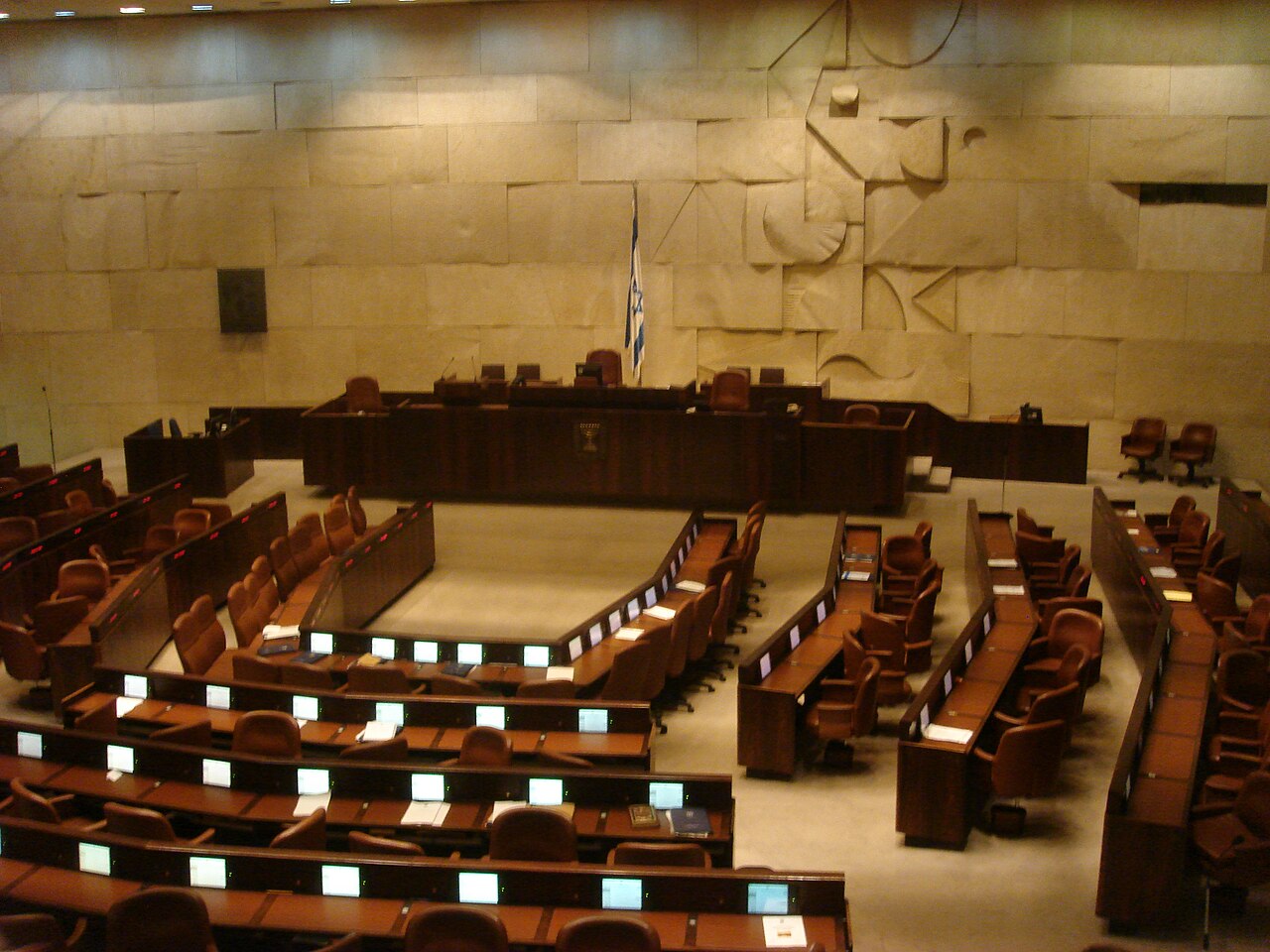
The 2026 count, party by party
The table is the final count published by the Central Elections Committee after the 27 October 2026 vote, with all votes counted and turnout at 77.9 percent. The results go to the president on 4 November and the 26th Knesset is sworn in on 10 November.
| Party | Led by | Seats |
|---|---|---|
| Netanyahu's bloc | 53 | |
| Likud, the main party of the right | Benjamin Netanyahu | 27 |
| Shas, Sephardi ultra-Orthodox | Aryeh Deri | 6 |
| United Torah Judaism, Ashkenazi ultra-Orthodox | Agudat Yisrael and Degel HaTorah | 7 |
| Otzma Yehudit, far right | Itamar Ben-Gvir | 7 |
| Religious Zionism-Zehut, settler right | Bezalel Smotrich | 6 |
| Eisenkot's bloc | 48 | |
| Yashar!, centre to centre-right | Gadi Eisenkot | 21 |
| Beyachad, right, anti-Netanyahu | Naftali Bennett | 12 |
| The Democrats, Labor and Meretz merged | Yair Golan | 8 |
| Yisrael Beytenu, secular right | Avigdor Lieberman | 7 |
| Arab lists, in neither bloc | 19 | |
| Joint List: Hadash, Ta'al and Balad | Yousef Jabareen | 11 |
| Ra'am, the Islamist United Arab List | Mansour Abbas | 8 |
Count: Times of Israel, 30 October 2026, from the Central Elections Committee final results.
Read the blocs, not the parties. Likud is the largest party and still short by eight even with every partner it has. Eisenkot's bloc mixes the right (Bennett, Lieberman), the centre (Yashar) and the left (the Democrats), held together by opposition to Netanyahu rather than by a shared programme.
"Left" and "right" in Israel mostly measure one thing: the Palestinians. Not taxes, not social policy. On that scale Eisenkot is centre-right. He opposes a Palestinian state, has called the two-state solution unrealistic, and backs settlement within Israeli law while promising to remove illegal outposts and stop settler violence. The real Israeli left, the camp that still argues for a Palestinian state, is the Democrats and Hadash, and it collapsed as a governing force after the Second Intifada (the Palestinian uprising of 2000 to 2005) and the Hamas takeover of Gaza.
The Arab parties, and why they may decide it
The claim you will hear this week is that Arab citizens of Israel have no voice in the state that rules them. The count answers it: 19 of 120 seats, more than the five that separate the two main blocs, won by Arab parties in a free election and counted the same night.
Two lists, two strategies
Ra'am, led by Mansour Abbas, is Islamist and pragmatic. It trades votes for results for Arab citizens: budgets, housing, policing. In June 2021 it became the first independent Arab party in an Israeli governing coalition, and its price was the budget: over 53 billion shekels in development plans for Arab society. It ran alone in 2026, hoping to be invited into the next coalition on its own terms.
The Joint List, headed by Yousef Jabareen of Hadash with Ahmad Tibi of Ta'al, was re-formed in reduced form before the vote, and has historically stayed in opposition. The two lists vote separately. One can back a government while the other votes no.
The math they control
- 53 seats, eight short. No Arab party will back him, and his partners would refuse the support if it were offered.
- He tried once. After the March 2021 election Netanyahu pursued Ra'am's outside support. Smotrich ruled out any government that leaned on Ra'am, even through its abstention, and Ra'am joined Bennett and Lapid instead, ending Netanyahu's twelve years in office.
- His path is defections: enough members of Eisenkot's bloc crossing over, or a unity government with Yashar.
- 48 seats, thirteen short of 61. A minority government needs only more votes for than against.
- 48 plus Ra'am's 8 is 56, three more than Netanyahu's 53, if the Joint List abstains. That is a government, on a three-seat margin.
- His stated rule is that coalition partners must accept the Declaration of Independence, a Jewish and democratic state, and service for all, which keeps the Arab parties outside the cabinet even if their votes put him in office. He has denied promising Bedouin leaders that Ra'am would join.
The leverage is real and has been used. On 17 April 2022, after Palestinian rioters stockpiled stones and fireworks inside the Al-Aqsa mosque and police moved in, Ra'am froze its membership in the coalition it had helped create. The government had already lost its one-seat majority, and it fell that June. A government that depends on an Arab party survives on that party's patience through every security crisis, and Israel does not have many quiet months.
The Haredi draft, the fight that broke the right
Netanyahu's natural partners are the two ultra-Orthodox (Haredi) parties, Shas and United Torah Judaism. The issue that split them from him was the army.
The exemption. Haredi men studying full-time in yeshivas (religious seminaries) were exempted from military service for decades, and as the community grew the exemption reached tens of thousands of men. On 25 June 2024 an expanded nine-justice panel of the Supreme Court ruled unanimously that the government had no legal basis to keep exempting them without a law, struck down the arrangement covering about 63,000 yeshiva students, and ordered state funding withheld from yeshivas whose students evade service.
Why it landed when it did. After October 7 the army needed soldiers, and reservists were serving hundreds of days. A carve-out that was a political deal in peacetime became, to most Israelis, a question of who bleeds for the country.
The rupture. When no exemption law passed, United Torah Judaism's leader resigned from the cabinet, and on 16 July 2025 Shas announced it was quitting every ministerial post, while saying it would not topple the government. Both parties are counted in Netanyahu's bloc again in 2026. Eisenkot's "service for all" condition is aimed squarely at them, and it is why the ultra-Orthodox parties have nowhere else to go.
What to watch next
The president's consultations. The final results reach President Herzog on 4 November and the Knesset is sworn in on 10 November.
Who the parties recommend to the president. The mandate goes to whoever can show a path to a government, not to the largest party by default.
What Ra'am asks for, and whether the Joint List stays out of the way. Between them they decide whether a 48-seat bloc can govern.
Whatever happens, it happens by count and by law. A bloc of 53 that cannot reach 61 does not govern, a prime minister who loses his majority leaves, and Arab citizens hold the swing vote in a parliament they were told they have no voice in. That is the system the word "apartheid" asks you not to look at. The full argument is on Is Israel a Democracy?
Read next
Sources
- Times of Israel: with all votes counted, Netanyahu bloc 53, Eisenkot bloc 48, Arab parties 19, 30 October 2026 · Central Elections Committee final results
- Times of Israel: 2026 Israeli elections, what you need to know (mandate, extensions, 21-day petition, 90-day election) · Israel Democracy Institute on forming a government
- Israel Democracy Institute: can a new government be put in place? (constructive no-confidence) · Times of Israel
- JNS: the Knesset votes its own dissolution, 62 to 0
- Jerusalem Post: what Eisenkot's Yashar stands for · The Arab Weekly on Eisenkot and statehood
- JNS: Eisenkot denies promising Ra'am a place in government; his three conditions
- The New Arab: Arab parties revive the Joint List · Joint List composition and slate
- Times of Israel: Ra'am joins the Bennett-Lapid coalition, June 2021
- Times of Israel: Smotrich rejects any coalition backed by Ra'am, 2021
- UPI: Ra'am suspends its coalition membership, 17 April 2022
- UPI: Supreme Court strikes down the religious draft exemption, 25 June 2024 · Israel Hayom
- Ynet: Shas announces government exit over the draft law · Ynet: UTJ chair resigns from cabinet
- Jerusalem Post: the end-of-March budget deadline and automatic dissolution